Stone Löyly or Iron Löyly? Soft Steam, Explained
By Saima Honkanen · Updated November 2026
In short
Finns call steam that rises only from hot stones kivilöyly, stone löyly, and steam from water striking hot metal or glowing elements rautalöyly, iron löyly. Most stove builders and old bathers prize stone löyly as softer and cleaner. A Finnish sauna researcher adds that no objective data yet ties stone properties to what bathers feel.
Paavo Eskelinen, a log builder, took about ten years to finish his own sauna, and the hardest part was one decision. “Continuous or single-fire, iron löyly or stone löyly?” he wrote in the Finnish Sauna Society’s magazine. “And if stone löyly, then single-fire.” He built the stove of refractory brick inside and old drying-barn bricks outside, and cast the stone supports, the lid and the door in refractory concrete. His summary of the result is the whole argument of this page in eight words: “So the löyly water touched iron nowhere.”
What is the difference?
Where the water lands. In kivilöyly, stone löyly, the water you throw meets only hot stone, and the steam rises from a body of heat that cools slowly. In rautalöyly, iron löyly, some of it reaches hot metal, a steel firebox top or a glowing electric element, and flashes off with a sharper hiss.
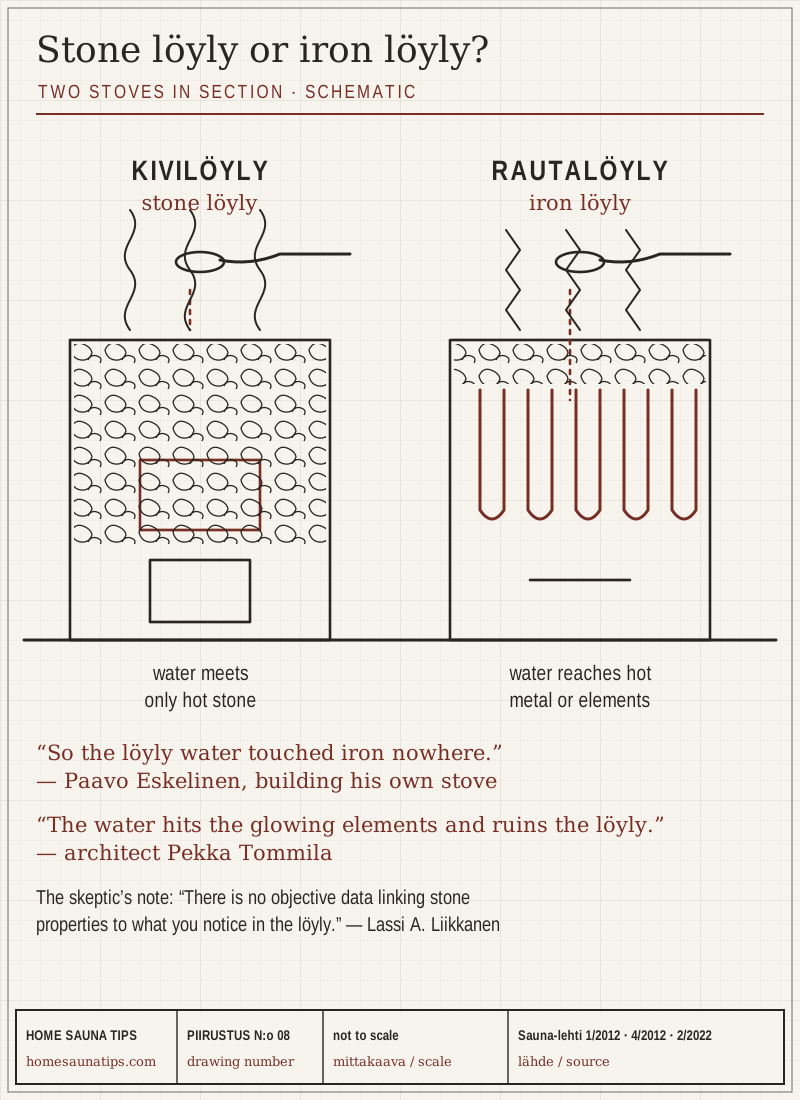
Finnish bathers describe the difference the way they describe weather. Architect Pekka Tommila, asked for the core of good löyly, answered: “The core of good löyly is clean stone löyly… from clean, proper stones, clean water and clean heating, that is where sauna pleasure comes from.” He once told a stove maker that on its model “the water hits the glowing elements and ruins the löyly, even though the stove is marketed as soft.” The model, the interview records, was withdrawn.
Why does stone löyly feel softer?
Mass, mostly. A deep pile of stones heated through releases steam steadily and keeps its temperature as the water lands; a thin layer over hot metal gives a burst and then sulks. The Society’s smoke-sauna stoves carry about 800 kilograms of stone, master stove tender A-P Paavola notes, against 30 to 60 in an ordinary home stove. The savusauna, with the most stone of all, is famous for the softest löyly in the tradition.
Teppo Hurme, who founded a Finnish ceramic-stone company, gives a more physical account. In a continuous stove whose interior runs, as he puts it, at “the temperature of the surface of Venus, 460 degrees,” with stones pressed against the elements, “impurities in the stone begin to evaporate into the air.” Good löyly, by contrast, is air that is “easy to breathe, and that’s what’s usually called soft löyly.” His prescription: “There should be exactly the right amount of stones.” He makes stones, which is worth knowing; the bathers agree with him anyway.
How do stove builders get stone löyly?
By hiding the iron. Eskelinen cast everything the water might touch. A 2017 news item on a new smoke-sauna stove reported its maker’s claim that the design has “no iron parts inside that the water can reach, so the löyly comes purely from the stones.” The same idea drives the open, mesh-walled stoves that reached Finland in the early 2000s; the magazine’s editor first met one, she wrote, “across the eastern border.” The principle, as a 2022 article put it: “put the heat source entirely inside the stones.”
Technique matters as much as hardware. Smoke-sauna builder Juha Telkkinen pours, rather than throws: “pour the water on the same spot; that makes soft löyly.” Tuohimaa’s stacking advice serves the same end: rounded stones on top, because “angular shapes cut performance and produce sting.”
Is there evidence for any of this?
Not of the measurable kind, and the most careful Finnish voice says so. Lassi A. Liikkanen, the sauna researcher, grants that “a good stone gives clean, calm löyly,” adds that “you can make löyly even from a steel flue,” notes that iron has been used for heat storage in stoves to the east, and concludes: “There is no objective data linking stone properties to what you notice in the löyly.” Stone löyly is the overwhelming judgment of experienced bathers. It is not yet a laboratory result, and we will not dress it up as one.
And the electric sauna?
It can give either. A journalist once proposed in a Finnish newspaper that electric saunas be renamed kuumio, roughly “a hot box,” to separate “harsh electric-stove rooms from gentle löyly buildings.” The magazine reprinted the line, one suspects, with some pleasure. The fair answer is that the stones decide. Fill the basket exactly as the manual specifies, so the elements stay covered and water lands on stone; restack and replace stones as they crumble; and pour gently onto the stones rather than flinging water at the casing. Tommila managed clean stone löyly from an electric stove he loaded with extra stones: “You get clean stone löyly if you’re patient.”
The practical detail is in our guides to electric sauna heaters, the kiuas and its stones, and what makes löyly soft or harsh. The firewood half of the bouquet is in firewood for a sauna stove.
Questions people ask
- What is soft löyly?
- Steam that arrives as a broad, even warmth rather than a sharp sting. Finnish bathers credit it to a large mass of stones heated through, water that meets only stone, and a gentle pour. Teppo Hurme, founder of a Finnish ceramic sauna-stone maker, describes it as air that is easy to breathe, which is what bathers usually call soft löyly.
- What is the difference between stone löyly and iron löyly?
- Where the water lands. In stone löyly (kivilöyly) water touches only hot stones; in iron löyly (rautalöyly) it reaches hot metal or glowing heating elements. Architect Pekka Tommila called clean stone löyly the core of good löyly and said water striking glowing elements ruins it.
- Does an electric sauna give iron löyly?
- It can, if water reaches the elements. A well-filled stone basket that keeps the elements covered, loaded exactly as the manual specifies, gives stone löyly from an electric stove too. Tommila reported getting clean stone löyly from a storage-type electric stove he loaded with extra stones, if he was patient.
- Is there scientific evidence for soft löyly?
- Not yet in a measurable form. Sauna researcher Lassi A. Liikkanen writes that there is no objective data linking stone properties to what bathers notice in the löyly. The preference for stone löyly is a strong and widely shared practitioner judgment, not a laboratory finding.
Sources
- Paavo Eskelinen — Hirsimiehen sauna; Pentti Tuohimaa on stacking stones; Raili Vihavainen on the mesh stove, Sauna-lehti 1/2012, pp. 13, 25, 28 (in Finnish)
- Raili Vihavainen, with Pekka Tommila — Sauna-lehti 4/2012, pp. 21–23 (in Finnish)
- Leena-Kaisa Simola, with Teppo Hurme — Sauna-lehti 4/2018, pp. 40–41 (in Finnish)
- Lassi A. Liikkanen — Kiuaskivissä kytee löylynsiemen, Sauna-lehti 2/2022, pp. 56–59 (in Finnish)
- Jaana Laitinen, with Juha Telkkinen — Sauna-lehti 3/2017, p. 26; Savuhiisi stove news item, Sauna-lehti 2/2017, p. 18 (in Finnish)
- Pekka Seppänen in Ilta-Sanomat, quoted in the Löylytasku column, Sauna-lehti 4/2014, p. 4 (in Finnish)
- Leena-Kaisa Simola, with A-P Paavola — Sauna-lehti 2/2018, p. 46 (in Finnish)
- Karoliina Saarnikko — on stoves with the heat source inside the stones, Sauna-lehti 4/2022, p. 67 (in Finnish)