Firewood for a Sauna Stove: What Finns Burn and Why
By Saima Honkanen · Updated November 2026
In short
Finns burn dry hardwood in the sauna stove, birch and alder above all, at 15 to 20 percent moisture. Peel birch first: the bark soots the stones and spoils the löyly. Alder is the traditional last load for a calm finish. Any dry wood works; never burn paper, cardboard, or rubbish.
In January 2012 the Finnish Sauna Society held a seminar, and the argument that broke out was about firewood. The magazine’s new editor reported it with a straight face: “A debate arose on how wood species and log size affect löyly. Compared with wines, does the stove hiss merlot or shiraz?” Her conclusion was the wine taster’s: the best one is the one that suits you. The stove tenders, being stove tenders, also had opinions.
What matters most?
Dryness, then everything else. A-P Paavola, master stove tender at the Society’s smoke saunas in Helsinki, wrote the rule for the magazine in 2026: “A log’s moisture must be under 20 percent, around 15–20.” He supplied the field test too: “Wet wood hisses like a cat as it catches.” Erkki Tanttu, the illustrator, who described his own smoke sauna in 1960, put it more simply: “With firewood, dryness matters most.”
Paavola’s second rule is just as short. “All species work as sauna wood. What matters is burning wood, not paper, cardboard or other rubbish.” Painted, treated or glued wood belongs in the same category, and so does anything your stove’s manual excludes.
How does each wood change the löyly?
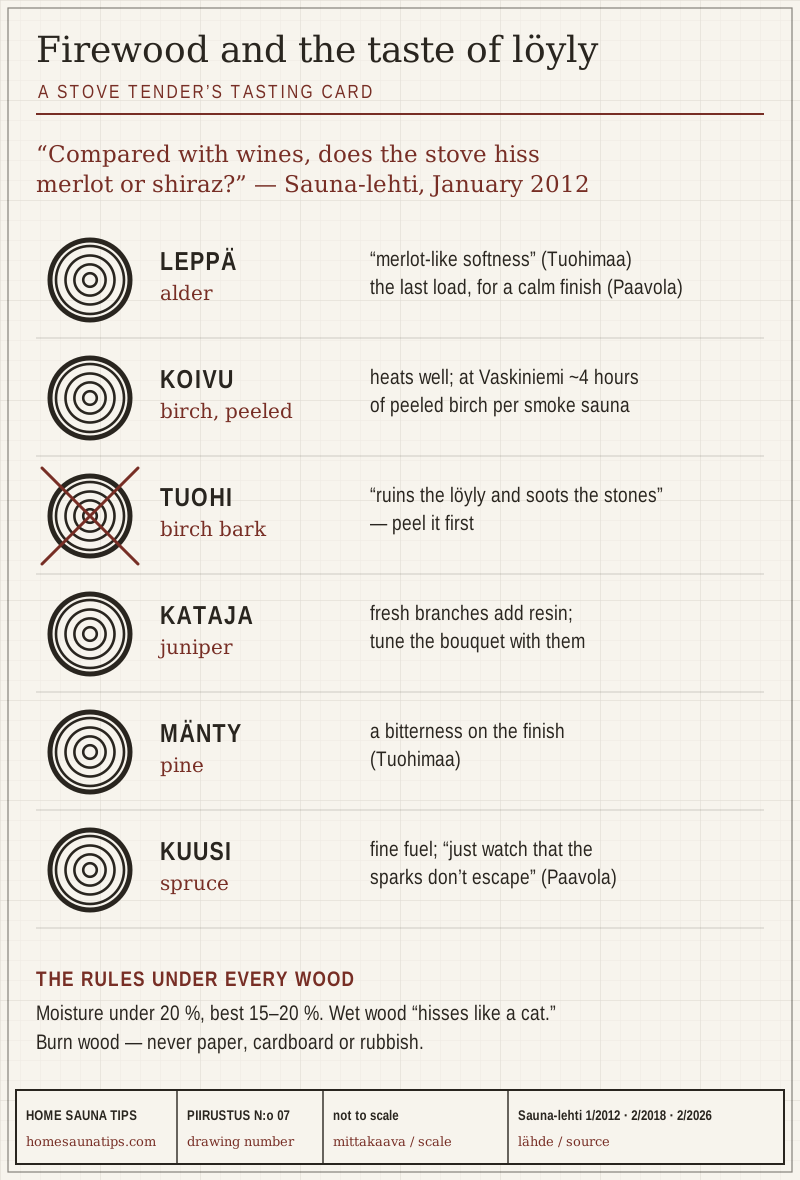
Here the wine talk begins in earnest. Pentti Tuohimaa, honorary chair of the International Smoke Sauna Club, gave the tasting notes: “Löyly’s bouquet can be described like wine. Its backbone is a clean, balanced smoke scent. On top come, for example, juniper’s resin, alder’s merlot-like softness or pine’s bitterness.”
| Wood | What Finnish stove tenders say |
|---|---|
| Leppä, alder | ”Merlot-like softness”; the last load, “to bring the heating to a controlled finish” |
| Koivu, birch, peeled | ”Heats well”; about four hours of it in the Society’s smoke saunas |
| Tuohi, birch bark | ”Ruins the löyly and soots the stones” |
| Kataja, juniper | Fresh branches adjust the bouquet with resin |
| Mänty, pine | A bitterness |
| Kuusi, spruce | Fine fuel; “just watch that the sparks don’t escape” |
Tuohimaa fires his smoke sauna with mixed wood split small, “like kindling”: pine, spruce, aspen and alder, with peeled birch welcome. He tunes the result “with fresh juniper branches and the ratio of conifer to broadleaf wood.” Tanttu adds the soot rule: broadleaf wood, except birch with its bark, soots less than conifer.
Not every Finn is so particular. One builder told the magazine he avoids “needless fussiness, like heating only with alder.” The cautionary tale runs the other way: at the 1956 Melbourne Olympics, the magazine reported, the Finnish team’s sauna was fired with very hard eucalyptus wood, which “gave very harsh löyly.”
Why does alder come last?
For a calm finish. At the Society’s smoke saunas Paavola burns peeled birch for about four hours, and “the last load is alder. Alder is good for bringing the heating to a controlled finish.” Finnish families hold the same view by inheritance. Timo Korkeaoja learned it as a boy, from a grandmother who carried the wrong logs back to the woodpile, and grew up hearing that “alder is the best heating wood, because it has no essential oils.” That last is family lore rather than chemistry, and it is held with great conviction.
How big should the logs be?
Small to start, heavier once the firebox is hot. Tuohimaa splits smoke-sauna wood very small. Heikki K. Lyytinen’s firing guide adds the second half: once the firebox has warmed, “use heavier wood, whatever the species.” Tanttu reported heating his sauna for two hours on a couple of armfuls of 60-centimetre alder and birch logs. For a modern stove, the manual’s maximum log length and load size come first; firebox doors and glass are designed for them.
What goes in the löyly water?
Water, mostly. Tuohimaa’s smoke-sauna rules: “Birch leaves can go in the löyly water, which of course comes from a spring.” Not perfumes, soaps or eucalyptus, “and nor does beer löyly,” he wrote, before adding, deadpan, “though I like it and sometimes throw it secretly.” Our guide to sauna scents covers the modern additives and why less is more.
What does this mean in North America?
Burn what grows near you, dry. Birch and alder are as easy to find across the northern United States and Canada as in Finland, and the same rules apply to maple, ash or oak: season it, split it, keep the bark off the stones. Store wood under cover with air around it, and bring a day’s supply into the dressing room to warm before it goes in the stove.
For the stove itself, see wood-burning sauna stoves and the kiuas, whose stones are the other half of the bouquet; stone löyly or iron löyly? explains why Finns care where the water lands. Then light the fire, listen for the cat, and decide for yourself whether your stove hisses merlot or shiraz.
Questions people ask
- What is the best wood for a sauna stove?
- Dry wood, first of all. The Finnish Sauna Society’s master stove tender says all species work as sauna wood and that what matters is burning wood, at under 20 percent moisture. Finnish preference runs to birch with the bark peeled, and alder, especially as the last load.
- Why do Finns peel birch for the sauna?
- Because birch bark burns sooty. Pentti Tuohimaa, honorary chair of the International Smoke Sauna Club, writes that birch bark ruins the löyly and soots the stones, while birch without its bark heats well. Bark makes good kindling outside the sauna; in a smoke sauna it is kept out.
- Why is alder used in saunas?
- For a calm finish and a clean scent. At the Society’s smoke saunas the last load is alder, which brings the heating to a controlled end. Tuohimaa credits alder with a merlot-like softness in the löyly, and one Finnish family held it was best because it has no essential oils.
- Can I burn pine or spruce in a sauna stove?
- Yes, if it is dry. Tuohimaa’s smoke-sauna mix includes pine and spruce split small, and Paavola says all species work. Spruce throws sparks, so watch the firebox door. Conifers soot more than hardwoods, and Tuohimaa notes that pine adds a bitterness to the löyly.
- How do you know firewood is dry enough?
- Measure it, or listen. Paavola wants under 20 percent moisture, ideally 15 to 20, and notes that wet wood hisses like a cat as it catches. A cheap moisture meter on a freshly split face settles the question.
Sources
- Leena-Kaisa Simola — editorial; Pentti Tuohimaa — Mikä tekee savusaunasta hyvän?, Sauna-lehti 1/2012, pp. 3 and 13 (in Finnish)
- A-P Paavola — Lämmitä kuin mestari: Hyvä halko kumisee, Sauna-lehti 2/2026, p. 59 (in Finnish)
- Leena-Kaisa Simola, with A-P Paavola — Lämmittäjän täytyy tietää saunat, tuulet ja savukaasut, Sauna-lehti 2/2018, p. 46 (in Finnish)
- Timo Korkeaoja — Madekivet saunan kiukaan sydän, Sauna-lehti 4/2018, p. 42 (in Finnish)
- Erkki Tanttu — Erkki Tantun savusauna (1960, revised 1976), Sauna-lehti 1/2018, p. 13 (in Finnish)
- Heikki K. Lyytinen — firing guide, Sauna-lehti 2/2022, p. 40 (in Finnish)
- Melbourne 1956 Olympic sauna, from Sauna-lehti 1/1957, recalled in Sauna-lehti 2/2016, p. 36 (in Finnish)