The Sauna at the Front: Finland’s Wartime Saunas
By Saima Honkanen · Updated November 2026
In short
Finnish soldiers in the Second World War built saunas wherever they stopped long enough: pits dug into the ground, lined and roofed with logs and earth, heated by a pile of stones. The army’s delousing saunas also held off typhus, bathing over 230,000 men a month from July 1943 to June 1944.
Armies march on their stomachs. The Finnish one, by its veterans’ account, also marched toward the next place it could heat a sauna. Alpo Reinikainen, remembering the war years for the Finnish Sauna Society’s magazine, described the question his men asked at every halt: “The men of the unit I led would ask whether we’d be staying here long enough to build a sauna. Almost always the answer was yes.”
How did soldiers build a sauna at the front?
Out of the ground and whatever the forest offered. Reinikainen’s description is a complete building specification in four sentences. “Any tree served for wall logs; the roof was spruce boughs, bark and earth, camouflaged with treetops. The stove was piled from stones. Three and a half hours later we were bathing.”
Kauko Ijäs, born in Sortavala in 1924, a staff sergeant who fought in both wars and served with the heavy artillery in the second, gave the magazine the same picture. “At the front we built dugout saunas. A pit in the ground, lined and roofed with logs. Stones were gathered into a corner, and somehow a firebox got made there too.” Ijäs fought at Valkeasaari, Tali-Ihantala and Äyräpää; a shell once landed about two metres from him. He kept the date: 16 May 1944.
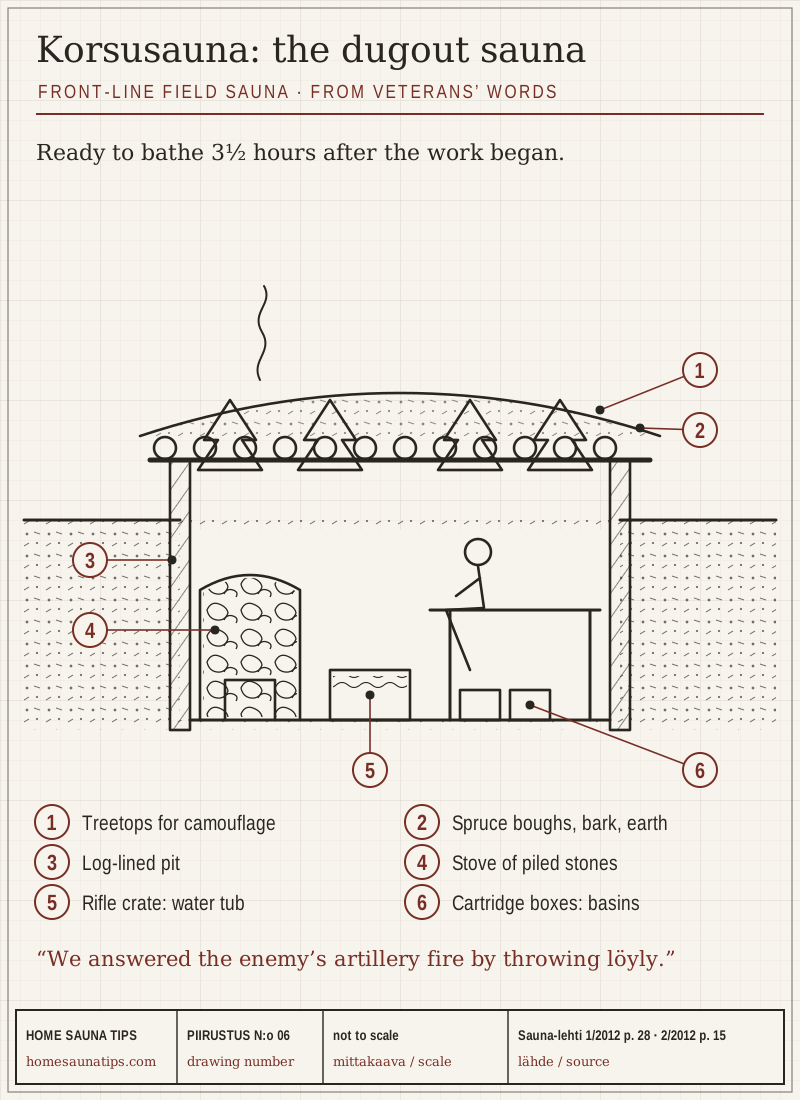
The fittings came from the supply dump. “A rifle crate for the water tub, cartridge boxes for wash basins, steam thrown with a mess-tin lid, whisks broken from spruce branches. The stove rumbled, the whisks slapped.” And then the line Finns still quote: “We answered the enemy’s artillery fire by throwing löyly.”
What was the lice war?
The sauna’s most important military job. Lice carry typhus, and typhus has emptied armies. In early 1942, Lasse Viinikka, the Society’s honorary chairman, writes, in places up to half of Finland’s soldiers had body lice. Finland’s answer rested on one fact: “heat above 70 °C kills lice, their eggs (nits) and the typhus bacterium.”
So the army built täisaunat, delousing saunas, and ran them like an assembly line. The soldiers’ clothes went into the heat; the soldiers went through a four-step drill.
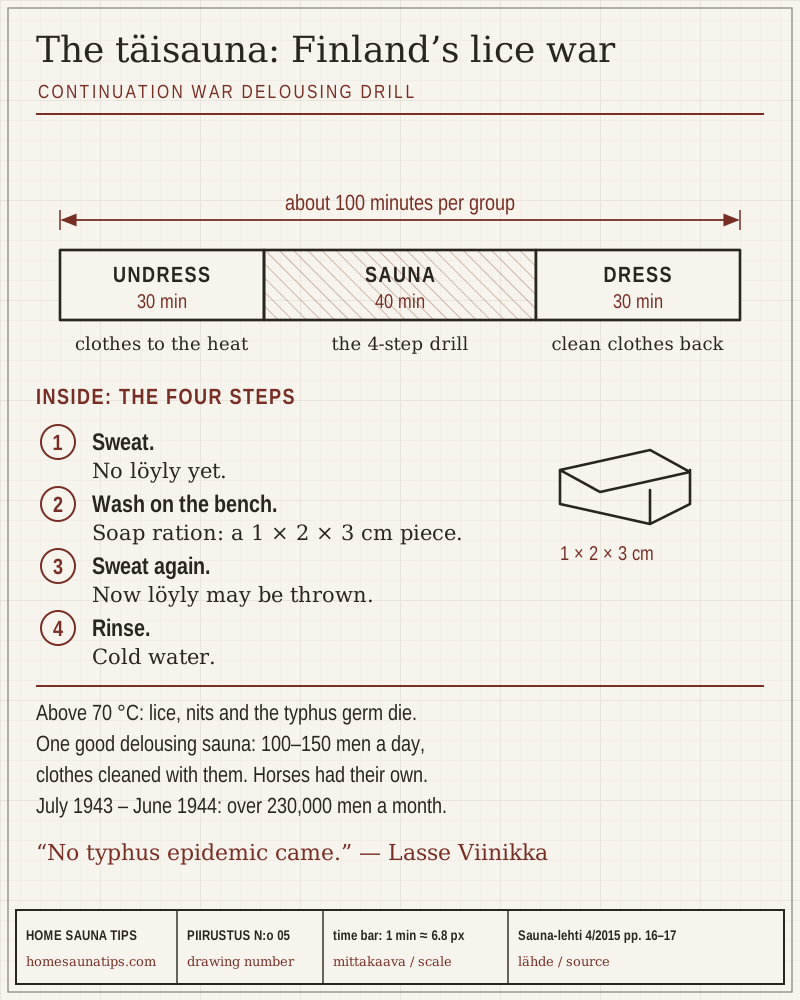
- Sweat, without löyly.
- Wash on the bench, with a soap ration of one piece, 1 × 2 × 3 centimetres.
- Sweat again, and now löyly may be thrown.
- Rinse with cold water.
The schedule allowed 30 minutes to undress, 40 for the sauna and 30 to dress. “One well-designed delousing sauna could bathe 100–150 people a day and clean their clothes.” From July 1943 to June 1944, over 230,000 men a month went through, and nearly 250,000 sets of clothing were cleaned. There were small casualties: metal buttons heated to 70–80 °C could burn. Horses had delousing saunas of their own, treated with sulphur gas, heads kept outside. Water came from wherever it could; one 1941 photograph shows men fetching it from a hole in the lake ice on the Karhumäki road.
Viinikka’s verdict is five words long: “No typhus epidemic came.”
What did the sauna mean to the men?
More than hygiene. A wartime photo caption from Rukajärvi, in White Karelia, says simply that the sauna “brought smiles to the wilderness soldiers.” Heikki K. Lyytinen puts the deeper version: the filth of the front was washed away, and men “were cleansed in spirit at the same time.” Viinikka, more drily: the sauna “could bring a welcome change from harsh front-line conditions.”
The commander-in-chief agreed. “Mannerheim took saunas, and often,” Jörn Donner told the magazine, “especially at Sairila manor, where he lived during the Continuation War.” In 1942 the 14th Division at Rukajärvi gave the marshal a hunting lodge for his birthday, the Marskin Maja. Major General Raappana gathered skilled men from across the companies to build it; more than sixty carpenters were needed. Mannerheim considered its sauna the best he had ever experienced. The lodge was taken down and re-erected at Loppi in 1945, where its bathing room still seats fifteen on the benches.
What came home after the war?
The scars, and the habit. Author Torsti Lehtinen remembered the public sauna of the post-war years: “many men were missing a limb, or shrapnel scars grimaced on their bodies.” Pekka Laaksonen saw the same in 1950s Lahti. Lehtinen also heard the war stories that filled the benches, and added his own deadpan footnote: “If every heroic deed in those stories had really happened at the front, maybe Finland would have won the whole war.” The old public saunas were where a great many of those stories were told.
Do Finnish soldiers still build saunas?
Wherever they are posted. “Finnish UN peacekeepers are known around the world for putting up a sauna first,” writes Juha Nirkko of the Finnish Literature Society’s archive, “their spiritual headquarters.” Donner, who bathed in the troops’ saunas on the Golan Heights and in Lebanon as a reporter, counted “dozens of sauna buildings” left in the Middle East as more or less permanent monuments to Finnish peacekeeping. Risto Elomaa reports at least 27 built for peacekeepers in Namibia. In 2009 the Finnish Sauna Society gave its Löylynhenki award to the UN peacekeepers and the Peacekeepers’ Museum. At home, Donner rated the Defence Forces’ sauna at Santahamina, on the shore of the Gulf of Finland, among the finest in the country.
The best first-hand account may be one we could not read: the magazine interviewed veteran Olavi Matilainen, who lived to 103, in its first issue of 2020, which is not yet in the Society’s online archive. If it appears, this page will grow. The older story of the sauna before and after the wars is in our history of the Finnish sauna.
Questions people ask
- Did Finnish soldiers really build saunas at the front?
- Yes, routinely. Veteran Alpo Reinikainen recalled that his men always asked whether they would stay long enough to build a sauna, and the answer was almost always yes. Staff sergeant Kauko Ijäs described the usual form: a pit in the ground, lined and roofed with logs, stones gathered in a corner, and somehow a firebox too.
- What was a korsusauna?
- A dugout sauna, from korsu, a dugout shelter. It was dug into the earth, lined with logs, roofed with logs, spruce boughs, bark and earth, and camouflaged with treetops. A pile of stones served as the stove. Soldiers improvised the rest: a rifle crate for a water tub, cartridge boxes for basins, a mess-tin lid for a ladle.
- What was a täisauna?
- A delousing sauna. In the Continuation War the Finnish army fought typhus, which lice spread, with heat: above 70 °C kills lice, nits and the typhus germ. Soldiers went through a set drill while their clothes were heated, and one sauna could handle 100 to 150 men a day. No typhus epidemic came.
- Where did Mannerheim take his sauna during the war?
- Often, according to Jörn Donner, and especially at Sairila manor, where he lived during the Continuation War. In 1942 the 14th Division at Rukajärvi built him a hunting lodge with a sauna, the Marskin Maja, as a birthday present; he considered its sauna the best he had experienced.
- Do Finnish soldiers still build saunas abroad?
- Finnish UN peacekeepers are known for it. Archive researcher Juha Nirkko writes that they put up a sauna first, as their spiritual headquarters. Jörn Donner counted dozens of sauna buildings left in the Middle East, and Risto Elomaa at least 27 built for peacekeepers in Namibia.
Sources
- Raili Vihavainen, quoting Alpo Reinikainen — Sauna-lehden kaksitoista vuotta, Sauna-lehti 1/2012, pp. 27–28; Jörn Donner interview, pp. 6–10 (in Finnish)
- Leena-Kaisa Simola — Kauko Ijäs: Karjalassa joka lauantai oli juhlapäivä, Sauna-lehti 2/2012, pp. 12–15 (in Finnish)
- Lasse Viinikka — Saunalla kuusijalkaista vihollista vastaan, Sauna-lehti 4/2015, pp. 16–17 (in Finnish)
- Marskin Maja sidebar, Sauna-lehti 3/2023, pp. 35–36 (in Finnish)
- Finnish Heritage Agency wartime photographs, Sauna-lehti 1/2021, p. 29 (in Finnish)
- Heikki K. Lyytinen — Onko suomalainen sauna enää pyhä?, Sauna-lehti 4/2021, p. 42 (in Finnish)
- Karoliina Saarnikko, with Torsti Lehtinen — Sauna-lehti 2/2021, p. 62 (in Finnish)
- Juha Nirkko, Finnish Literature Society — Tontun koti ja köyhän apteekki, Sauna-lehti 2/2016, p. 58 (in Finnish)
- Jörn Donner speech, Sauna-lehti 4/2012, p. 17; Pekka Laaksonen, p. 28 (in Finnish)
- Karoliina Saarnikko, with Risto Elomaa — Sauna-lehti 4/2023, p. 27 (in Finnish)
- Löylynhenki award list (2009: UN peacekeepers and the Peacekeepers’ Museum), Sauna-lehti 1/2018, p. 21 (in Finnish)