Finland’s Old Public Saunas and the Women Who Washed
By Saima Honkanen · Updated November 2026
In short
Finland’s public saunas grew up in the towns of the late 1800s, when fire rules and crowded wooden housing left workers with nowhere to bathe. Helsinki had over a hundred in the 1950s. Bathrooms emptied them; a few survive, led by Tampere’s Rajaportti, open since 1906, and a new generation has opened since.
Olavi Friberg moved into a flat on Kaarlenkatu, in Helsinki’s working-class Kallio district, more than seventy-five years before he wrote to the Finnish Sauna Society’s magazine. The flats were under 20 square metres, with no bath. “It was a stroke of luck,” he remembered, “if some businessman built a place nearby where you could wash more than your face.” For most of a century that stroke of luck had a name in every Finnish town: the yleinen sauna, the public sauna.
Why did Finland need public saunas?
Because the towns made private ones nearly impossible. Erkki Helamaa traces it to fire regulations, which after a run of town fires made “building town saunas so hard that townspeople were being left without saunas. But soon public saunas, paid bathing establishments, came to the rescue.” Industry did the rest. “In Pori, public saunas multiplied in the late 1800s with industrialisation and urban growth,” Sanna Kuusikari found; a worker who heard the factory whistle again at dawn had no time to heat a sauna of his own.
The early ones were plain. People “stripped naked in a shared changing room regardless of sex”; curtain-divided rooms and separate turns for men and women spread only in the 1900s. The keepers did laundry on the side and sold jauhokalja, a flour-brewed small beer, and a few, Kuusikari notes, sold something stronger that they should not have.
Who was the saunottaja?
The woman in charge. Heikki Hirvonen, who visited a Hämeenlinna public sauna as a six-year-old in 1945, never forgot her: “The sauna’s ruler was the bath-lady in her white outfit.” Her brush “scrubbed the body… the most ticklish spots were the armpits and the soles of the feet.”
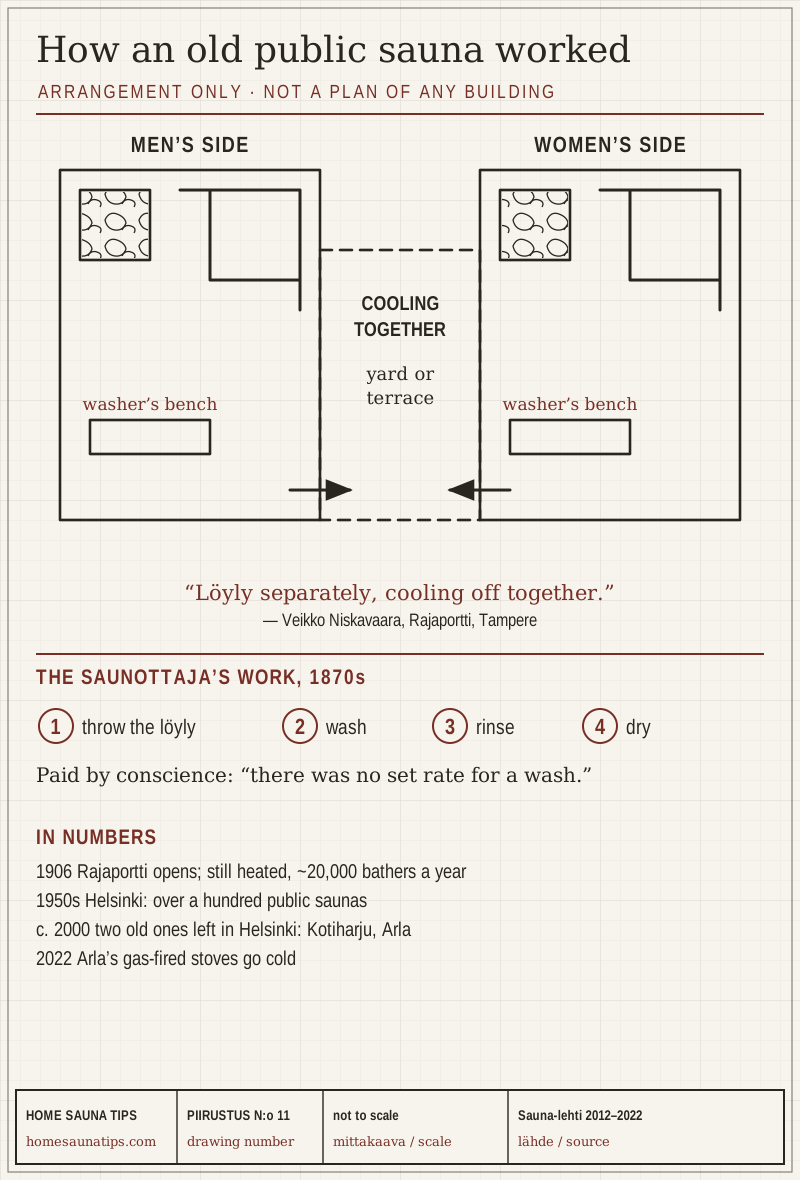
Her job description survives from the Dahlström sauna in Jyväskylä in the 1870s: “During the bath the saunottaja threw the löyly, then washed, rinsed and dried the bathers.” Payment was a matter of honour. At Rajaportti in the 1950s and 1960s, Ari Johansson remembered, “there was no set rate for a wash; everyone paid what their conscience told them.”
The washers have not entirely gone. Jaana Pietilä, a washer at Helsinki’s Sauna Hermanni, described her ideal customer in 2012 with professional relish: “A person being washed can have plenty of mass and girth… a stout one is good under the brush!” But washes, the magazine noted in 2023, “are now offered in only a few public saunas.”
How many were there?
Enough to need a trade union. Kimmo Helistö, who ran Helsinki’s Sauna Arla, counts “over a hundred public saunas” in Helsinki in the 1950s; Tampere had some 140 over its history. A union of commercial saunas, founded in 1943, reached about 300 members. During the war attendance fell because, as Risto Elomaa drily put it, “the male customers were at the front,” and Helsinki set up a sauna committee to guarantee everyone “a proper sauna bath at a reasonable price at least once a week.”
Then the flats got bathrooms. “The fading was slow but sure,” Friberg wrote. “Losing the customers took over 20 years; people don’t change their habits easily.” His building’s own sauna ended up as a room for drying laundry. By the turn of the millennium, Helistö says, Helsinki had only two old public saunas left: Kotiharju and Arla.
Which old public saunas survive?
A few, protected and much loved.
| Sauna | Since | What to know |
|---|---|---|
| Rajaportti, Tampere | 1906 | Finland’s oldest working public sauna; about 20,000 bathers a year |
| Kotiharju, Helsinki | 1928 | Wood-heated; just over a hundred bathers a day, 550 one Christmas Eve |
| Sauna Hermanni, Helsinki | 1950s | Its washer was still at work in 2012 |
| Sauna Arla, Helsinki | late 1920s | Gas-fired from 1970; closed when gas prices soared in 2022 |
Rajaportti was built by the merchant couple Mooses and Maria Lahtinen and is, the magazine says, the only people’s sauna from the time of the Russian Empire still in near-original condition. A local sauna society was founded in 1989 to stop its demolition. Its manager, Veikko Niskavaara, sums up the arrangement: “Löyly separately, cooling off together.” Arla’s end was blunter. “Vladimir Putin drove the last nail into Arla’s coffin,” Helistö wrote in 2022. “The price of gas has risen more than tenfold.”
Are public saunas coming back?
In a new form. “People used to come to the public sauna to wash,” Hannu Olkinuora told the magazine in 2013. “Now they come for good löyly and to meet people they know.” In Helsinki a new generation opened: Kulttuurisauna, whose founders mortgaged their own home and signed a 30-year lease with the city; Löyly; and Helistö’s own Uusi Sauna, in 2018. Kotiharju’s benches, says Kari Lindstedt, who first bathed there in 1955, are now “the best place to practise your English.”
Public-sauna manners differ a little from a home sauna’s; sauna etiquette covers them, and the Saturday sauna and the sauna at the front tell more of the stories the old benches heard. If you visit Finland, go to one of the old ones on a weekday afternoon, book a wash if you can, and pay what your conscience tells you.
Questions people ask
- Why did Finland have public saunas?
- Because town dwellers could not have their own. Fire regulations made town saunas hard to build, and workers in crowded wooden houses had nowhere to wash. Public saunas, paid bathing establishments, filled the gap from the late 1800s, multiplying with industry and the growth of the towns.
- What is the oldest public sauna in Finland?
- Rajaportti in Tampere, founded in 1906 on the border of Tampere and Pohjois-Pirkkala, is Finland’s oldest working public sauna and the only people’s sauna from the time of the Russian Empire still in near-original condition. A local sauna society was founded in 1989 to stop it being torn down.
- What did a sauna washerwoman do?
- The saunottaja kept the benches and buckets in order and washed the bathers: she threw the löyly, scrubbed with a brush, rinsed and dried them. In many saunas there was no set rate; everyone paid what their conscience told them. A few public saunas still offer a wash.
- Do men and women bathe together in Finnish public saunas?
- Usually not in the hot room. Late-1800s town saunas often had a shared changing room, but separate turns and divided rooms became common in the 1900s. At Rajaportti the rule is: löyly separately, cooling off together, in the shared yard.
Sources
- Sanna Kuusikari — Yleisiä ja yhteisöllisiä saunoja yli sata, Sauna-lehti 3/2017, pp. 20–23 (in Finnish)
- Erkki Helamaa — on town saunas and fire rules, Sauna-lehti 3/2013, p. 12 (in Finnish)
- Leena-Kaisa Simola — Rajaportin 110-vuotiasta saunaa ei ikä paina, Sauna-lehti 2/2016, pp. 45–47 (in Finnish)
- Heikki Hirvonen — Saunahetkiä ja -muistoja 1940-luvulta, Sauna-lehti 1/2013, pp. 22–23 (in Finnish)
- Olavi Friberg — reader’s letter; Risto Elomaa on Kulttuurisauna, Sauna-lehti 3/2012, pp. 18 and 36 (in Finnish)
- Kimmo Helistö — Sauna Arla on kuollut – eläköön yleinen sauna, Sauna-lehti 3/2022, p. 66 (in Finnish)
- Saunaseminaari and Rajaportti coverage, Sauna-lehti 2/2013, pp. 12–18 (in Finnish)
- Leena-Kaisa Simola — Saunotaan yhdessä!, Sauna-lehti 3/2015, p. 12 (in Finnish)
- Jaana Pietilä interview, Sauna-lehti 2/2012, p. 18 (in Finnish)
- Risto Elomaa — on the business saunas’ union and Helsinki’s sauna committee, Sauna-lehti 3/2016, pp. 40–41 (in Finnish)
- Kotiharju and protection by the Finnish Heritage Agency, Sauna-lehti 2/2021, pp. 59–60 (in Finnish)
- Ulla Ora — public saunas at Christmas, Sauna-lehti 4/2024, p. 35 (in Finnish)