How Finland Nearly Lost Its Smoke Saunas
By Saima Honkanen · Updated November 2026
In short
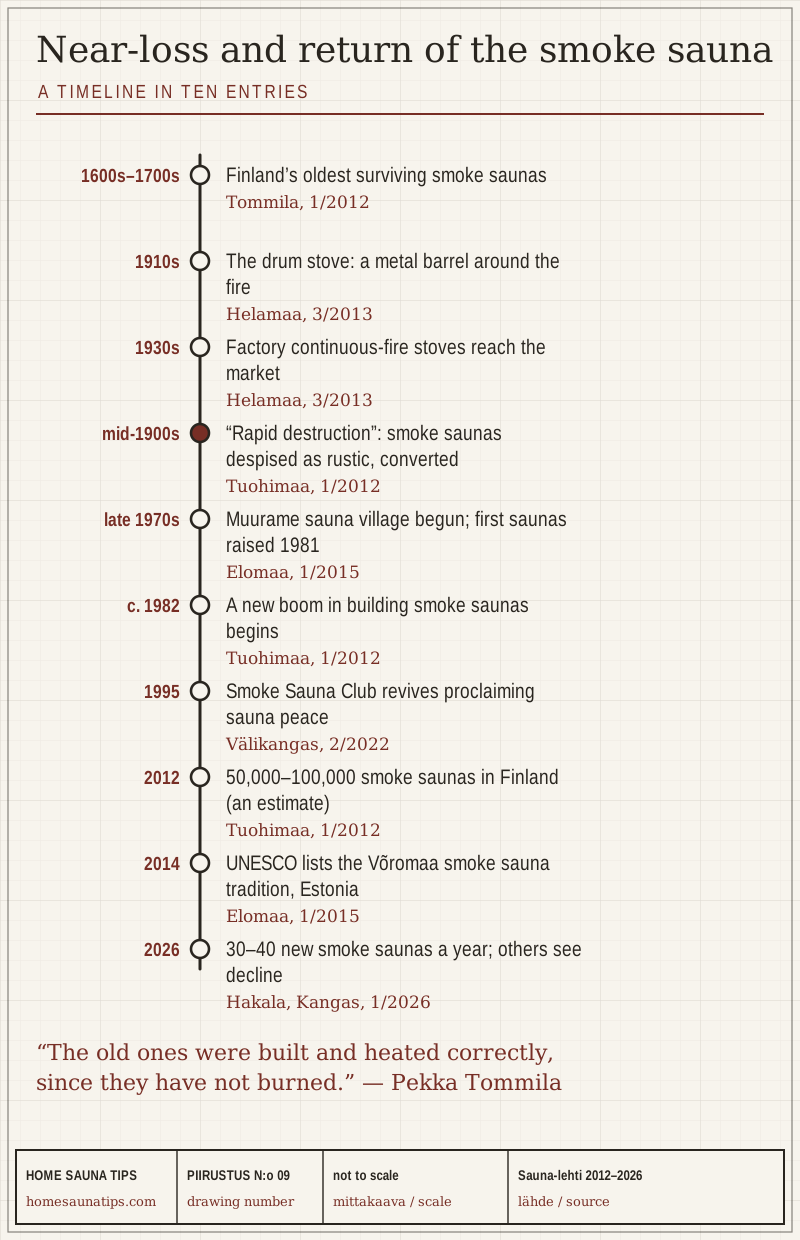
In the mid-twentieth century Finland nearly abandoned the smoke sauna. Stoves with chimneys looked like progress, and smoke saunas were despised as rustic and converted. A revival began around 1980 with sauna villages and smoke-sauna clubs; by 2012 one expert estimated Finland had 50,000 to 100,000 smoke saunas again.
“Finland’s oldest smoke saunas date from the 1600s–1700s,” architect Pekka Tommila told a Finnish Sauna Society seminar. “The old-timers were clearly built and heated right, since they haven’t burned down!” The joke has a sting in it. Smoke saunas that survived three centuries of fire nearly did not survive the twentieth century’s idea of progress.
What happened to the smoke sauna?
It went out of fashion faster than it could burn down. The savusauna, the chimneyless smoke sauna, had been the Finnish sauna for as long as there was one. Then came stoves that kept the smoke out of the room: the barrel-shelled drum stove in the 1910s, factory-made continuous-fire stoves in the 1930s, as Erkki Helamaa’s history of the stove records. Each was easier, quicker and cleaner.
Pentti Tuohimaa, honorary chair of the International Smoke Sauna Club, describes what followed. In the middle of the last century Finnish smoke-sauna culture underwent a rapid destruction: the new stoves were seen as the measure of progress, and smoke saunas were despised as marks of rusticity in a quickly urbanising Finland. They were converted to modern, easier saunas. Some were simply lost. One, at Harju in Jyväskylä, was on its way to becoming firewood. It was saved, Risto Vuolle-Apiala told the magazine, by paying its owners “the same amount in birch logs.”
Who brought it back?
A handful of stubborn people, beginning in the late 1970s.
Risto Vuolle-Apiala and the sauna village. The architect began collecting endangered saunas from around Finland and re-erecting them at Muurame, near Jyväskylä. Development began in the late 1970s and the first saunas went up in 1981. The collection grew to 29 smoke saunas, the oldest from the 1700s. Twenty-three of them were later moved to Jämsä. Keeping such a place alive is hard; in 2013 one visitor, fresh from Estonia, called it “shameful” that Finland was letting it decay.
The builders. Around 1982, Tuohimaa writes, a new boom in smoke-sauna building began. By the turn of the millennium the magazine’s editor could report private owners, sauna clubs and tourism businesses competing to open ever better smoke saunas, and a tradition, “strongly revived,” that was “in its heyday today.”
The Tampere club. The International Smoke Sauna Club, founded by Eero Välikangas, tested hundreds of smoke saunas and in 1995 revived the proclamation of saunarauha, sauna peace, after what Välikangas calls a gap of about two hundred years. The Society honored him that year.
What did Estonia have to do with it?
It got to UNESCO first. In 2014 the smoke sauna tradition of Võromaa, in southern Estonia, was inscribed on UNESCO’s Representative List of the Intangible Cultural Heritage. In Võru and Setomaa, Risto Elomaa noted, the tradition had stayed strong even through the Soviet era. Lasse Viinikka, the Society’s honorary chairman, says the Estonian listing “finally woke us up” to pursue Finland’s own bid, and sauna culture in Finland followed onto the list in 2020.
Is the smoke sauna out of danger?
Opinions differ, as they should. Writing in 2026, Pentti Hakala, the Society’s Löylynhenki laureate, saw the direction changed for good: “for decades smoke saunas were disappearing entirely… now the direction has changed,” with about 30 to 40 completed each year. Pentti-Oskari Kangas, founder of the Herrankukkaro sauna village at Rymättylä, disagreed in the same article: “We’re in a period of disappearance now.” The count Tuohimaa offered in 2012, 50,000 to 100,000 smoke saunas, was his own estimate; nobody keeps a register.
What has not changed is the skill. A smoke sauna is a day of fire in a wooden building, and the savusauna guide explains how Finns heat one without becoming part of the statistics. The tradition’s own rules of conduct, the bow and the quiet, are in the low sauna door and the quiet sauna.
Can North Americans help keep it going?
By bathing in one, first. Then, if the idea takes hold, by building with care, which is to say with a builder who has fired one, a site well clear of other buildings, and the local fire authority’s blessing. The longer story of the sauna before and after the smoke sauna’s eclipse is in our history of the Finnish sauna. The oldest survivors are still standing, Tommila would remind you, because someone heated them correctly.
Questions people ask
- Why did smoke saunas almost disappear in Finland?
- Because they looked old-fashioned. In the middle of the twentieth century, Pentti Tuohimaa writes, new stoves with chimneys were seen as signs of progress, and smoke saunas were despised as marks of rusticity in a fast-urbanising Finland. Many were converted to easier, modern saunas; others were torn down.
- How old is the oldest smoke sauna in Finland?
- The oldest survivors date from the 1600s and 1700s, according to architect Pekka Tommila, who drew the obvious conclusion: they were built and heated correctly, since they have not burned. The Muurame sauna village’s oldest smoke sauna is from the 1700s.
- What was the Muurame sauna village?
- An open-air museum of rescued saunas near Jyväskylä, assembled by architect Risto Vuolle-Apiala from the late 1970s. The first saunas went up in 1981 and the collection reached 29 smoke saunas. Twenty-three of them were later moved to Jämsä.
- How many smoke saunas are there in Finland today?
- Nobody counts them. In 2012 Pentti Tuohimaa estimated 50,000 to 100,000. In 2026 Pentti Hakala put new construction at about 30 to 40 a year, while another veteran, Pentti-Oskari Kangas, argued that a new period of disappearance has begun.
Sources
- Pentti Tuohimaa — Mikä tekee savusaunasta hyvän?; Raili Vihavainen — Sauna-lehden kaksitoista vuotta, Sauna-lehti 1/2012, pp. 11–13 and 26–28 (in Finnish)
- Erkki Helamaa — Rantasaunan juuria kaivamassa; Jussi Niemelä on Võrumaa, Sauna-lehti 3/2013, pp. 11–16 and 23 (in Finnish)
- Risto Elomaa — on Muurame and Võromaa, Sauna-lehti 1/2015, pp. 20 and 28 (in Finnish)
- Risto Vuolle-Apiala interview and fact box, Sauna-lehti 2/2021, pp. 28–29 (in Finnish)
- Lasse Viinikka — on Finland’s UNESCO bid, Sauna-lehti 1/2021, p. 24 (in Finnish)
- Eero Välikangas — on proclaiming sauna peace, Sauna-lehti 2/2022, p. 72 (in Finnish)
- Karoliina Saarnikko — Savusaunan tulevaisuus – onko sitä?, Sauna-lehti 1/2026, p. 42 (in Finnish)
- UNESCO — Smoke sauna tradition in Võromaa, Representative List (2014)