The Low Sauna Door: Why Finns Bow to Enter
By Saima Honkanen · Updated November 2026
In short
Traditional Finnish sauna doors are low to keep the heat in. With the top of the door at or below the foot bench, the hot air above it, the löyly pocket, stays put when someone comes in. A high threshold keeps the cold air low, and everyone bows on the way through.
Walk into an old Finnish smoke sauna and the building corrects your posture for you. The door is short, the sill is high, and the only way through is a bow. Visitors take it for quaintness. It is a heat-saving device that happens to double as good manners, and Finnish stove tenders will explain both halves with equal seriousness.
What is the löyly pocket?
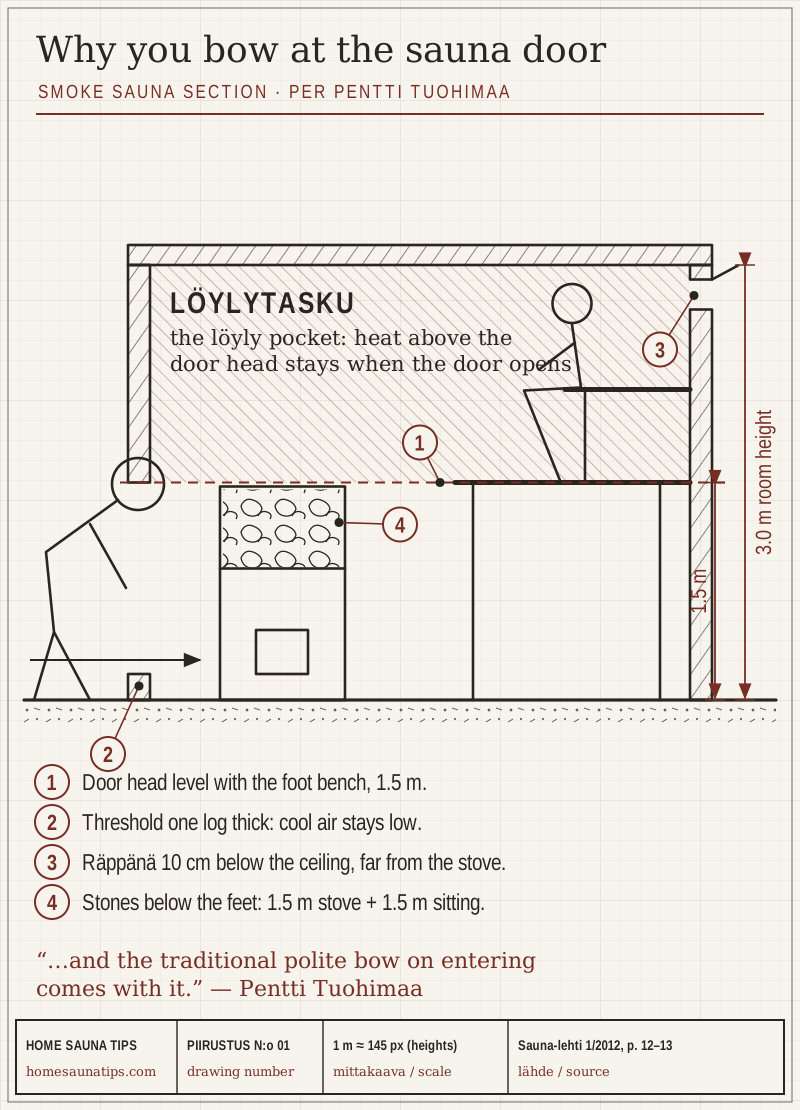
The heat the door cannot reach. Hot air rises and gathers high in the room; a door that opens only below that layer lets out cool air and nothing else. Finns call the trapped layer the löylytasku (the löyly pocket).
Pentti Tuohimaa, honorary chair of the International Smoke Sauna Club, gave the rule in Sauna-lehti, the Finnish Sauna Society’s magazine, in 2012: “The foot level of the benches is 1.5 metres from the floor, and the top of the door goes at the same height, so you get a good löyly pocket.” Pentti Hakala, the Society’s Löylynhenki laureate of 2022, put the history in one line: smoke saunas once had low doors “so that a löyly pocket would form. The bathers stayed above the top of the door, where the heat held even when people went in and out.”
How much heat is at stake? An old calculation by Vikholm, published in the magazine in 1979 and recalled in 2022, put it at “as much as 20 % of a sauna’s energy loss” from opening the door. Sauna engineers of every era have hated a warm draught going out the wrong way.
How low is low?
Lower than the stones, by most Finnish rules. The builders state it four slightly different ways, and they agree on the principle.
| Who | The rule |
|---|---|
| Pentti Tuohimaa | Door head level with the foot bench, both 1.5 m above the floor |
| Juha Telkkinen, smoke-sauna builder | ”The top of the door must be lower than the top of the stove stones” |
| Erkki Tanttu, illustrator, 1960 | Lintel “at about chin height,” because leak points up high must be avoided |
| Kimmo Pohjanpalo | ”A low door and a high threshold,” like an old storehouse; his own door is about a metre high |
Pohjanpalo rebuilt his cottage sauna’s doorway to get it right: two rows of logs added above the door “to get a proper löyly pocket,” and one more at the bottom “so there’s no draught.” Telkkinen gives the payoff in practical terms. Below the stone line, “the heat doesn’t escape and smoke doesn’t slip into the dressing room.”
Why the high threshold?
To keep the cold where it belongs, and to warn your head. Tuohimaa wants “a threshold as thick as a log, so the air doesn’t change when the door is opened.” Telkkinen adds the human reason: “The threshold must be high so the bather notices the door in the dimness. Otherwise you hit your head on the lintel.” A high step makes you look down; looking down makes you bow; bowing saves your forehead. Finnish design is often this economical.
Is the bow only about the door?
No. Tuohimaa’s 2012 article says it outright: with the door at that height, “this also produces the traditional polite bowing greeting as you enter the sauna.” Telkkinen finishes the thought: “You go into a smoke sauna, and come out of it, humbly.” Saija Silén, the Society’s Sauna Master of 2021, has the sharper version: entering a smoke sauna you must bow humbly, and “the proud man’s head knocks on the door frame.”
Older customs make the greeting explicit. Writing about the Mari, Tver Karelia and Võru in southern Estonia, Tuohimaa records that on entering the sauna “one bows and greets it with at least ‘hello sauna’, often also ‘hello stove’.” Heikki K. Lyytinen describes the threshold itself as the border of a sacred room, crossed naked and unprotected, “as into a bear’s den, to be reborn.” It is the same building in which Finns were born, healed, and washed for the last time, and the low door kept a little ceremony at its entrance. The quiet that follows is the subject of the quiet sauna.
Can an ordinary door make a löyly pocket?
Partly, with a strip of felt. Hakala’s workaround for a normal-height door is the simplest idea in this article: “On a normal-height door you can hang a felt or rug about half a metre long from the top of the door while bathing, to form a löyly pocket inside.” The International Smoke Sauna Club reports success with the same thing under the name löylyverho, a löyly curtain, for saunas where the door cannot be brought below the stove.
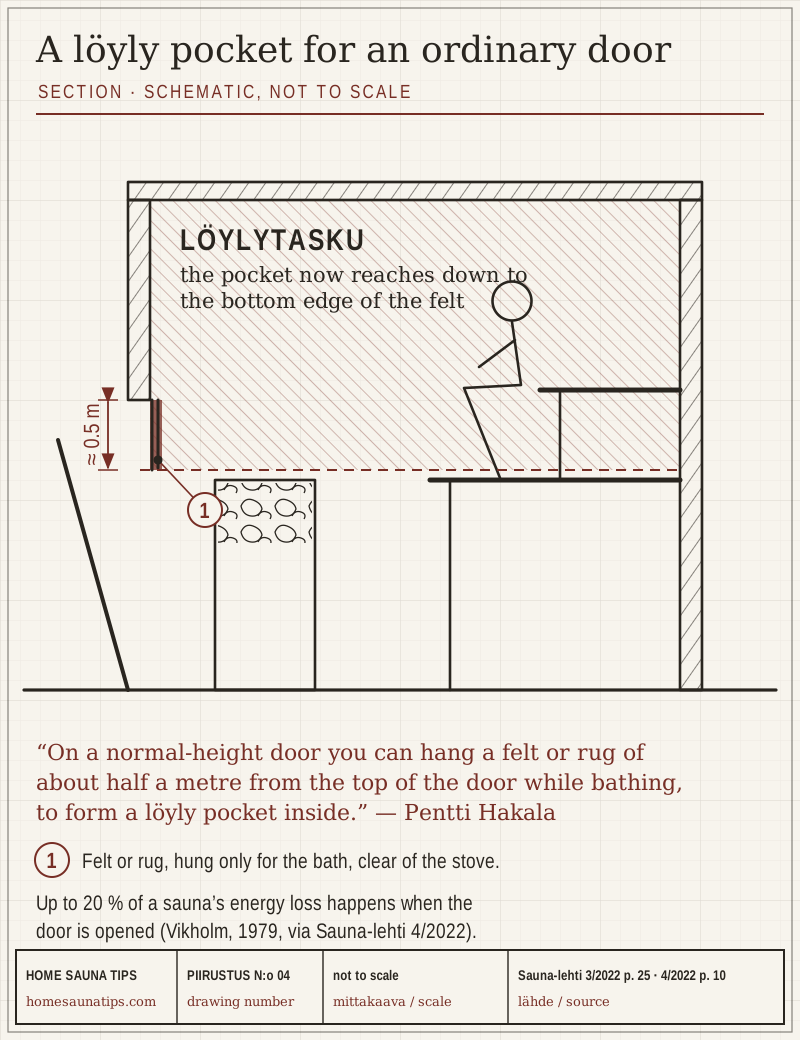
Three cautions are ours, not Hakala’s. Hang it only for the bath, as he says. Keep it well away from the stove and its clearances. And the door must still swing outward and open with a light push, as our guide to sauna doors and windows explains; a curtain that snags the leaf defeats the point.
What about glass doors?
They leak heat both ways. The magazine’s energy advice in 2022 was blunt: most of a sauna’s heat passes “through the glass door and structures into the rest of the building.” A full-height glass door gives up the pocket and the bow together. It may still be the right choice for light or a view; just know what it costs, and that no felt curtain will make it a smoke-sauna door.
Should a North American sauna copy the low door?
Copy the principle; check the rules before you copy the dimensions. In a detached outbuilding the old proportions work exactly as they always did: benches high, door head at or below the feet, stones below both, as our bench guide and the lauteet explain from the bench side. Inside a house, building, egress and accessibility requirements may set the minimum opening, and they win. Where the door must be tall, the felt curtain recovers some of the pocket. Where it can be low, bow on the way in. The stove will not notice. The sauna, Finns will tell you, does.
Questions people ask
- Why are old sauna doors so low?
- To keep a pocket of hot air above the door head. Bathers sit above it, so opening the door lets out only the cooler air near the floor. Pentti Hakala, honored by the Finnish Sauna Society in 2022, explains that smoke saunas once had low doors so that a löyly pocket would form and the heat held even when people came and went.
- What is a löyly pocket?
- Löylytasku in Finnish: the body of hot air trapped in the upper part of the sauna, above the top of the door. Because hot air rises and stays high, a door whose head sits at or below the bathers’ feet can open and close without emptying the heat where people are sitting.
- Why do Finns bow when entering a sauna?
- Partly because the door makes them, and partly out of respect. Pentti Tuohimaa calls the bow under a low lintel the traditional polite greeting on entering the sauna. In parts of Russian Karelia, among the Mari and in southern Estonia, bathers still bow and greet the sauna aloud, and often the stove too.
- Can I get a löyly pocket with a normal-height sauna door?
- Partly. Pentti Hakala’s suggestion is to hang a felt or rug about half a metre long from the top of the door while bathing, which forms a löyly pocket inside. Hang it only for the bath, keep it well clear of the stove, and make sure the door still opens outward with a light push.
- Is a high threshold safe in a sauna?
- Tradition says it is safer, not less safe: builder Juha Telkkinen says the high sill makes you notice the door in the dim light, so you bow instead of striking the lintel. In a North American home sauna, local building and accessibility rules may limit threshold height; check them before you copy a smoke-sauna doorway.
Sources
- Pentti Tuohimaa — Mikä tekee savusaunasta hyvän?, Sauna-lehti 1/2012, pp. 11–13 (in Finnish)
- Jaana Laitinen, with Juha Telkkinen — Savusaunan lämmittäminen kysyy kärsivällistä mieltä, Sauna-lehti 3/2017, p. 26 (in Finnish)
- Karoliina Saarnikko, with Pentti Hakala — Sauna-lehti 3/2022, p. 25; energy tips, p. 12 (in Finnish)
- Löylyverho säästää energiaa saunassa, citing Vikholm (1979), Sauna-lehti 4/2022, p. 10 (in Finnish)
- Kimmo Pohjanpalo’s restored smoke sauna, Sauna-lehti 4/2014, p. 20 (in Finnish)
- Erkki Tanttu — Erkki Tantun savusauna (1960, revised 1976), Sauna-lehti 1/2018, p. 12 (in Finnish)
- Pentti Tuohimaa — Unohdettu saunan pyhyys, Sauna-lehti 2/2018, p. 32 (in Finnish)
- Päivi Ketolainen, with Saija Silén — Sauna-lehti 3/2021, p. 28 (in Finnish)
- Heikki K. Lyytinen — Onko suomalainen sauna enää pyhä?, Sauna-lehti 4/2021, p. 41 (in Finnish)