How a Finnish Surgeon Took His Sauna in 1945
By Saima Honkanen · Updated November 2026
In short
Professor Simo Brofeldt, a Finnish surgeon, wrote down his sauna routine around 1940: exercise first, sit dry until the first sweat, rounds of seven to ten minutes, three or four trips outside, wash after the second break, cool in the lake, and dress slowly. The whole bath took one and a half to two hours.
Some time around 1940, a Finnish surgeon sat down with a questionnaire from the Friends of the Finnish Sauna and answered it the way a surgeon would: with the room’s dimensions, the stove’s model number, the starting temperature, the humidity in grams per cubic metre, and every step of the bath in order. He died in 1942. His answer was printed in 1945. In the 1990s his grandson found it, copied it for the family as a Christmas greeting, and had it framed for the shore sauna of his childhood home, where he often takes his Christmas sauna. “Time after time I read it and find ever new dimensions in it,” he wrote. “Find your own.”
Who was he?
Professor Simo Brofeldt, surgeon, rheumatic, and keen bather. He joined the Finnish Sauna Society in 1939 and went straight onto its medical section, later its board. From 1940 he sat on the sauna committee of Finland’s Olympic project, whose task was to build the best possible saunas for the athletes’ village. His grandson, Petteri Ormio, adds that he earned the Mannerheim Cross for bringing wounded soldiers out of an encirclement in East Karelia, and believes he was the only doctor to do so. He was 48 when he wrote the answer below.
The questionnaire’s sender is worth a word. “Friends of the Finnish Sauna,” Suomalaisen Saunan Ystävät, was the Society’s own first name. It was founded in Helsinki in November 1937, with the physician K. F. Hirvisalo as its first chairman, and organized itself into four sections: medical, technical, historical, and propaganda. Its stated duty, the magazine recalled in 2017, came from “both the national interest and the sauna’s recognised importance for public health and fitness.” Brofeldt was precisely the member it wanted: a doctor who measured.
What was his sauna like?
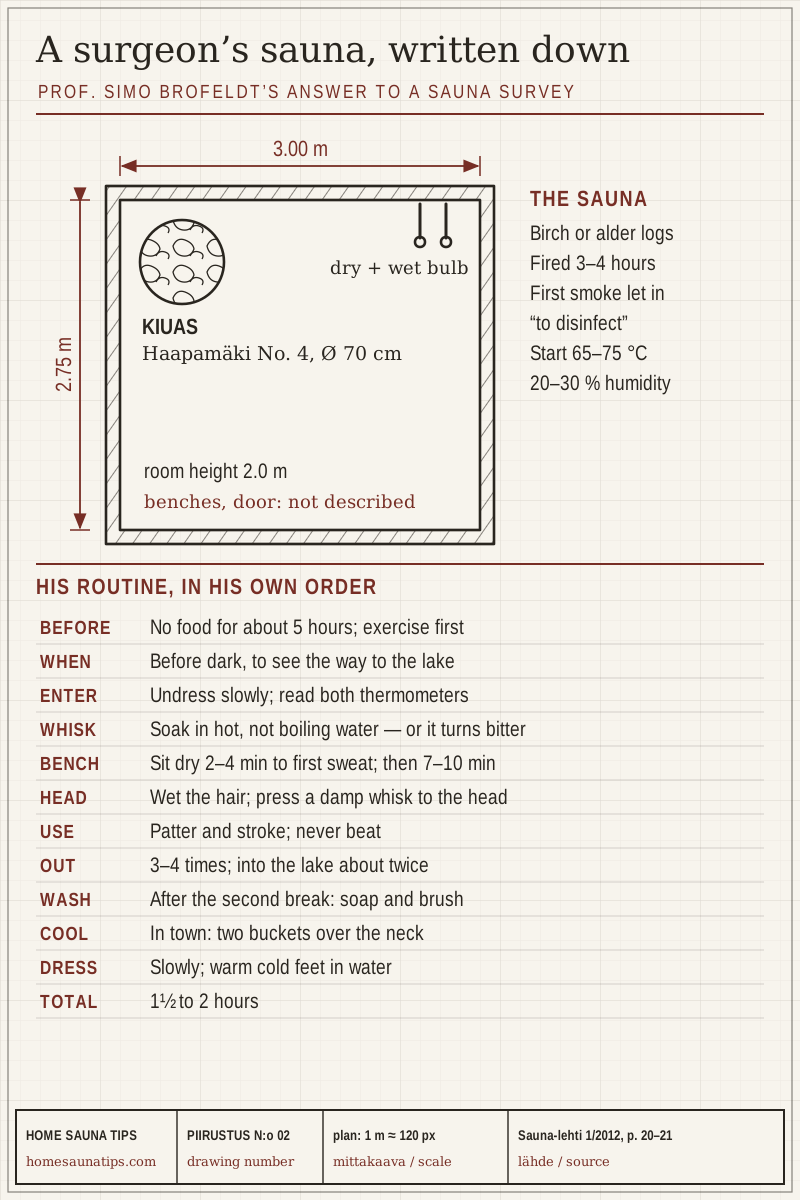
Small, wood-fired, and instrumented. A country sauna 3 metres by 2.75, 2 metres high, with a Haapamäki No. 4 stove 70 centimetres across. He heated it with birch or alder for three to four hours and, in the old way, let the first smoke into the room “to disinfect the sauna.” It started at 65–75 °C with 20–30 percent humidity, and he noted, correctly, that as the heat rises the humidity falls. On entering he read two thermometers, dry and wet.
How did he bathe?
In order, and without hurry. His steps, as he wrote them:
- Prepare the body. He avoided eating for about five hours beforehand and preferred to arrive after exercise, already starting to sweat, ideally “before dark and so that one can see to walk into the lake.”
- Undress calmly, so that he could step into the sauna “with the organs in their full normal state.” Open the hatch, read the thermometers.
- Prepare two waters. Cold for rinsing; hot but not boiling for soaking the whisk. “It feels as if too hot water released a bitter scent from the whisk.”
- Sit dry. On the bench without throwing water, until the first sweat: two to four minutes. Moistening the air at once, he believed, piles heat into the body too fast.
- Stay until the heat builds. About seven to ten minutes at first, sitting as in a reclining chair with his feet up on a rail, or lying flat when he wanted the heat to work.
- Mind the head. Wet the hair, and press a damp whisk to the head.
- Whisk gently. “I don’t beat with all my strength but tap lightly and stroke in turns.” So, he had heard, did the Khanty and Mansi, then called Ostyaks and Voguls.
- Go out three or four times. In summer into the water, about twice.
- Wash after the second break, with soap and brush, slowly; in the soap-short war years, with the whisk lathered instead, since whisk water is mildly alkaline.
- Cool properly. The lake while it is open. In town, a cold tub, or two buckets over the neck, which he preferred to a shower.
- Dress slowly. If the cooling had been so thorough that the feet stayed cold, warm them in water.
Between rounds he drank weak, lightly sweetened juice, sometimes warmed on the bench. He used a sauna sheet throughout to rub himself dry. The whole bath took an hour and a half to two hours.
What did he do for his rheumatism?
The opposite of moderation, deliberately. On days he bathed to treat his rheumatism, he aimed for an “effective heat build-up”: lying on the bench without washing or fussing, rinsing with lukewarm water, then wrapping himself in sheets and blankets warmed in the sauna to keep the heat treatment going another half hour, before wiping off the sweat and dressing.
That was a surgeon treating himself in 1940, and it belongs in the history of Finnish medicine, not in your bathing plan. The Society’s own early research agenda, recorded in its 1950 magazine, listed the questions doctors were still asking about sweating, metabolism and the heart. The answers we have now are in our sauna safety guide and sauna health evidence.
What has changed since?
Mostly the thermometer, a little. The Society’s founders argued about heat from the start. Harald Teir, a later chairman, called 70–80 °C acceptable, 90 °C the limit, and 100 °C overheating; he even lent his name to a unit, the teir, a quarter of an hour at 80 °C, which he later trimmed to ten minutes. By the early 2000s the Society’s definition of a sauna ran from 70 to 100 °C.
| Brofeldt, about 1940 | Finnish practice now | |
|---|---|---|
| Starting heat | 65–75 °C, 20–30 % humidity | 70–100 °C by the Society’s definition (2000s) |
| First minutes | Sit dry until the first sweat | Rinse first; löyly when the room asks for it |
| Rounds | 7–10 minutes at first | By feel, roughly 5–20 minutes |
| Whisk | Soaked hot, never boiling; tapped, never beaten | The same |
| Cooling | Lake, or two buckets over the neck | Lake, plunge, shower, snow |
| Length | 1½–2 hours | As long as the evening allows |
The rest has not moved at all. Go before dark. Mind the whisk water. Sit dry a moment. Go out and come back. Dress slowly. Our guide to how to take a sauna gives the modern version step by step, and the vihta or vasta covers the whisk he treated so carefully.
Ken elää, se näkee — whoever lives will see. Brofeldt did not live to see his answer printed. It has been read in a shore sauna every Christmas since.
Questions people ask
- Who was Simo Brofeldt?
- A Finnish surgeon and professor (1892–1942) who joined the Finnish Sauna Society in 1939, served on its medical section and board, and from 1940 sat on the sauna committee of the Finnish Olympic project. His grandson Petteri Ormio reprinted his sauna routine in Sauna-lehti in 2012.
- How long did a traditional Finnish sauna last?
- Brofeldt’s own bath took an hour and a half to two hours: several rounds on the bench, three or four trips outside, a wash, and a slow dressing. That is unhurried by modern standards, and Finnish practice still is. There is no fixed length; leave the bench when you have had enough.
- Did Finns throw water right away?
- Not in Brofeldt’s routine. He sat dry first, so the first sweat would come without the heat piling up in the body, which he believed happened too easily when the air was moistened at once. That took him two to four minutes. Löyly came after.
- How did he use the whisk?
- Gently. He soaked it in hot but not boiling water, because water that was too hot seemed to release a bitter scent, and he did not beat with all his strength but tapped lightly and stroked in turn. He also pressed a damp whisk to his head to keep the heat off it.
- Is his routine safe to copy today?
- Parts of it are timeless and parts are history. Exercise, unhurried rounds, real cooling and slow dressing are still good practice. His heat treatment for rheumatism, wrapped in warm blankets for half an hour more, was his own medicine and not advice; see our sauna safety guide before you change your bath.
Sources
- Simo Brofeldt and Petteri Ormio — S. A. Brofeldtin saunatavat (survey answer printed in Joulusauna, 1945), Sauna-lehti 1/2012, pp. 20–21 (in Finnish)
- Leena-Kaisa Simola — Alussa oli vain aate; Lasse Viinikka on K. F. Hirvisalo; Marja Martikainen — Sattumia vuosikymmenten varrelta, Sauna-lehti 2/2017, pp. 26–41 (in Finnish)
- Tuula and Marja Martikainen — Saunalehden seitsemän vuosikymmentä, Sauna-lehti 2/2016, pp. 32–34 (in Finnish)
- Leena-Kaisa Simola — Saunatalo 70 vuotta, Sauna-lehti 1/2022, pp. 13–26 (in Finnish)