HUUM CLIFF vs STEEL: The Smaller Body Can Need More Room
By Saima Honkanen · Updated November 2026
In short
CLIFF 9 has the narrower body and about half the advertised stone capacity of STEEL 9. That does not mean it occupies less usable room: their clearance requirements differ. Compare the complete installation envelopes in the current US manuals before choosing. STEEL favors stone reserve; CLIFF favors a smaller body and exposed-stone appearance.
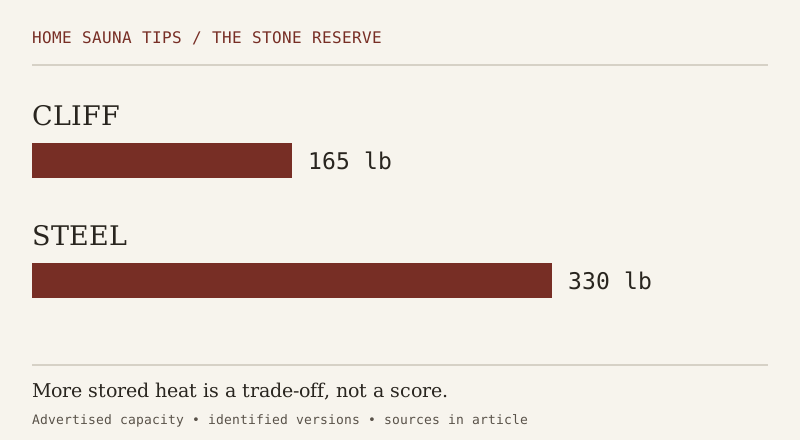
Advertised stone capacities. Body width alone does not determine the required installation space.
Aren’t these just two versions of the same heater?
They are related designs, but the difference is substantial. This comparison uses the standard CLIFF 9 and STEEL 9 at 240 volts, not the smaller Mini variants. Both use a separate UKU control system and an internal air tunnel. Their housings, stone capacity, and clearance drawings differ.
| Specification | CLIFF 9 | STEEL 9 |
|---|---|---|
| Body width and depth | About 10.6 × 10.6 inches | About 12.6 × 12.6 inches |
| Body height | About 38.4 inches | About 38.4 inches |
| Advertised stones | About 165 lb | About 330 lb |
| Specified stone diameter | About 1.2–2 inches | About 1.2–2 inches |
| Controls | Separate UKU | Separate UKU |
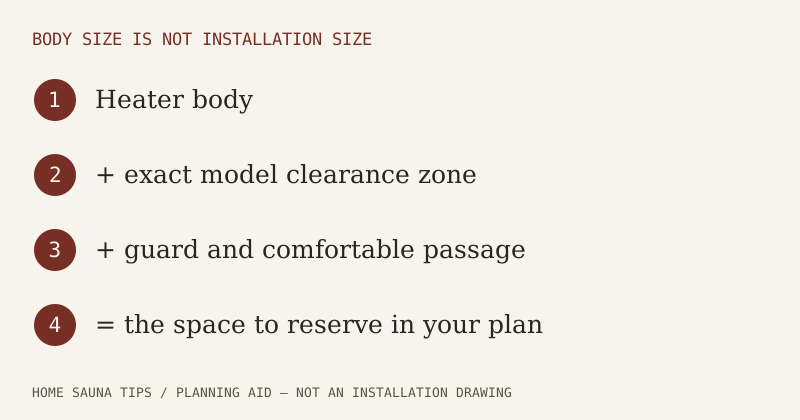
The dimensions describe the appliance body. They do not describe a safe opening between wooden benches.
How can the narrower heater require more space?
Clearances measure the gap between hot equipment and surrounding materials. They depend on the tested construction, not just body size. A more open design and a more enclosed one need not have the same gap.
The current US diagrams are the place to compare the actual envelopes. Do not substitute the 6 kW model’s gap for the 9 kW model’s, or infer that two related products have interchangeable clearances. Place the correct drawing over your floor plan and mark every combustible surface, including bench edges and a nearby door.
Then add the guard and space for a person to pass. The smallest technically permitted gap is not a comfortable walking aisle. If a smaller body needs a larger surrounding gap, the larger-looking heater can leave more usable room. This is why shopping by product thumbnail fails.
What does STEEL’s extra stone reserve buy?
More potential stored heat for repeated water throwing, once the rock is hot. It also buys more stones to handle and more mass to heat. Both compared versions are nominally 9 kW, so doubling the advertised stone load does not double the power available to warm it.
We would lean toward STEEL where a long evening with repeated rounds is the point and the installation fits. We would not call it twice as good. Steam sensation depends on where water lands, stone temperature, airflow, and the dose. A smaller well-heated bed can be more satisfying than a larger one entered too early.
CLIFF makes sense when its exposed-stone design is the preference and its full installation envelope works. The smaller body alone is not a buying argument until the clearance drawing has been checked.
Is the tall shape good for a low sauna?
Not automatically. Both bodies reach roughly 38.4 inches before any adjustment or installation detail is considered. Draw a section through the room with bathers seated on the upper bench. Where are their feet? Where does the warm air gather? Where does fresh air arrive?
An open-sided heater changes heat exchange along the column, so the top-of-stones rule is a design aid rather than an exact boundary. It remains sensible to question a low bench beside a tall heater. Changing the heater’s finish will not change the bench elevation.
See ventilation and heater sizing before finalizing the room. Neither a tall column nor a large stone load cures stagnant air.
What is the maintenance difference?
Both specify relatively small sauna stones. Do not substitute the larger stones intended for another HUUM model merely because the bag carries the same brand. The specified size and loading pattern are part of how air moves through the heater.
Keep access for unloading stones and reaching service points. A beautifully tight bench surround can turn routine inspection into a carpentry job. An embedding flange is an accessory with its own installation requirements, not permission to push boards close to the heater.
Which one should go on the quote?
Whichever passes the room drawing first. After that, choose STEEL for the larger reserve if the household will use it; choose CLIFF when the more exposed design and smaller body are worth its particular clearance requirements.
Get a complete quote with the same control capability, correct stones, guard, and installation. Treat advertised rapid-heating percentages as manufacturer claims, not a measured comparison between these two heaters in your room. The useful result is a comfortable sauna, not a victory for a percentage on a brochure.